
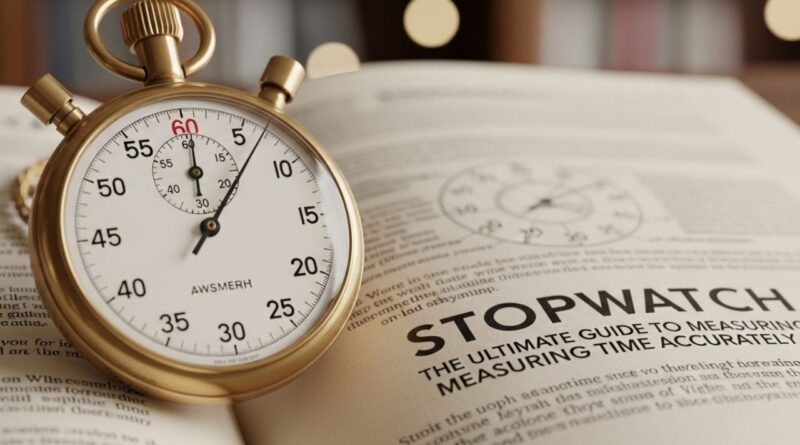
Stopwatch: The Ultimate Guide to Measuring Time Accurately
A stopwatch is a precision timekeeping device used to measure intervals of time. Unlike a regular clock, which shows the current time, a stopwatch starts timing only when activated, making it ideal for sports, scientific experiments, and everyday tasks that require accuracy.
Stopwatches have evolved from mechanical devices to digital gadgets and mobile apps, providing users with a variety of tools for measuring time efficiently.
What Is a Stopwatch?
A stopwatch is designed to record the amount of time elapsed from the moment it is started until it is stopped. Stopwatches can be mechanical with a spring mechanism or digital, providing readings down to milliseconds. Many smartphones and smartwatches now feature built-in stopwatch functions, making this tool accessible to everyone.
Stopwatches are widely used in multiple domains, including athletics, education, research, and workplace productivity.
History of the Stopwatch
The stopwatch was first developed in the 19th century as a mechanical instrument to measure short intervals accurately. These early devices relied on gears and springs and were commonly used in sports and scientific studies.
With the advent of electronics in the 20th century, digital stopwatches became popular. They offered higher accuracy, easy-to-read displays, lap timing, and memory storage. Modern devices, including smartphones and smartwatches, have made stopwatch technology widely accessible.
Types of Stopwatches
1. Mechanical Stopwatches
-
Operate using gears and a spring mechanism.
-
Durable and battery-free.
-
Often less precise than digital models.
2. Digital Stopwatches
-
Use electronic circuits for high-precision timing.
-
Can measure milliseconds.
-
Often come with features like lap memory and alarms.
3. Smartphone Stopwatches
-
Integrated into phones and smartwatches.
-
Offer convenience, portability, and extra features.
-
Perfect for casual users and fitness enthusiasts.
How a Stopwatch Works
Mechanical Stopwatches
Pressing the start button activates the gears and spring, moving the hands on the dial. Pressing stop halts the timer, and reset returns it to zero.
Digital Stopwatches
Use a quartz crystal oscillator to generate precise electronic pulses. These pulses are counted and displayed digitally, often down to hundredths of a second.
Key Features of Modern Stopwatches
-
Start/Stop Button: Begins and pauses timing.
-
Reset Function: Returns the timer to zero.
-
Lap/Split Time: Records intermediate times without stopping the main timer.
-
Memory Storage: Saves multiple lap times for analysis.
-
Water Resistance: Suitable for swimming and outdoor use.
Applications of Stopwatches
Sports and Athletics
Stopwatches are essential for timing races, sprints, swimming, and other sports. Coaches and athletes use them to track performance and improvement.
Education
Teachers and students use stopwatches in classrooms and labs to time experiments, quizzes, and tests.
Scientific Research
Researchers measure reaction times, process durations, and other time-sensitive experiments using stopwatches.
Fitness and Training
Interval workouts, HIIT exercises, and circuit training rely on precise timing. Stopwatches help maintain consistent performance.
Workplace and Industrial Use
Time-motion studies and productivity analysis in factories and offices often use stopwatches to optimize workflow.
Advantages of Using a Stopwatch
-
Provides precise measurement of time intervals.
-
Portable and easy to use.
-
Useful in a wide variety of fields.
-
Helps monitor performance, progress, and efficiency.
Stopwatch vs Timer
-
Stopwatch: Counts up from zero to measure elapsed time.
-
Timer: Counts down from a preset time.
Both are useful but serve different purposes.
Tips for Choosing the Right Stopwatch
-
Determine the purpose: sports, lab experiments, or casual use.
-
Choose digital models for higher accuracy.
-
Consider durability and water resistance for outdoor activities.
-
Check the display for readability in all lighting conditions.
The Future of Stopwatches
With the rise of wearable technology, stopwatches are integrated with smartwatches and fitness trackers. These devices combine timing with heart rate monitoring, GPS tracking, and performance analytics, making them invaluable tools for athletes, researchers, and everyday users.
Conclusion
The stopwatch is a versatile tool that has evolved from mechanical precision instruments to modern digital devices. It is indispensable for anyone needing accurate time measurement, whether for sports, research, or everyday tasks. From tracking lap times to managing productivity, the stopwatch continues to be an essential part of modern life.