
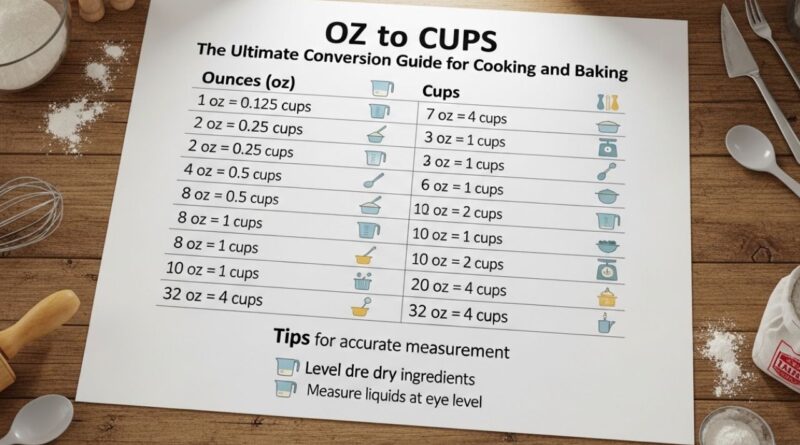
OZ to Cups: The Ultimate Conversoin Guide for Cooking and Baking
Cooking and baking often require precise measurements to achieve the best results. One common conversion that confuses many people is oz to cups. Understanding how ounces (oz) translate into cups is crucial, whether you are following a recipe, adjusting serving sizes, or experimenting with new dishes. This guide will explain the basics of oz to cups, provide formulas, and offer practical tips for accurate conversions in the kitchen.
What Does OZ Mean in Cooking?
In culinary terms, oz stands for ounces, a unit of weight or volume depending on the ingredient. In the United States:
-
Fluid ounces (fl oz): Measure liquid volume, e.g., water, milk, or oil.
-
Ounces (oz): Measure weight or mass, e.g., flour, sugar, or butter.
Understanding the difference is essential when converting oz to c ups, as the type of ingredient affects the measurement.
Basic OZ to Cups Conversion
The standard conversion from ounces to cups is:
-
1 cup = 8 fluid ounces (fl oz) of liquid
For liquids like water, milk, or juice, converting oz to cu ps is straightforward. For example:
-
16 fl oz = 2 cups
-
24 fl oz = 3 cups
-
32 fl oz = 4 cups
For dry ingredients, the conversion depends on the density of the ingredient. For instance:
-
Flour: 1 cup ≈ 4.25 oz
-
Sugar: 1 cup ≈ 7 oz
-
Butter: 1 cup = 8 oz
These differences are critical because using the wrong conversion can alter the outcome of a recipe.
How to Convert Easily
1. For Liquids
Use the simple formula:
Cups=Ounces (fl oz)8\text{Cups} = \frac{\text{Ounces (fl oz)}}{8}
Example: If a recipe calls for 24 fl oz of milk:
24÷8=3 cups24 ÷ 8 = 3 \text{ cups}
2. For Dry Ingredients
Conversion depends on the ingredient’s weight:
Cups=Ounces (oz)Weight per cup\text{Cups} = \frac{\text{Ounces (oz)}}{\text{Weight per cup}}
Example: If you have 12 oz of flour:
12÷4.25≈2.82 cups12 ÷ 4.25 ≈ 2.82 \text{ cups}
3. Using Conversion Charts
For convenience, many cooks use oz to c ups conversion charts for common ingredients. These charts reduce errors and save time while cooking.
Why Accurate OZ to Cups Conversion Matters
-
Baking Precision: Unlike cooking, baking requires exact measurements. Incorrect conversions can cause cakes to collapse or cookies to spread too much.
-
Consistent Taste: Following accurate conversions ensures your recipes taste the same every time.
-
Portion Control: Accurate measurements help control serving sizes, calories, and nutritional content.
Common Mistakes When Converting
-
Confusing weight and volume: Remember that oz can measure weight (dry ingredients) or volume (liquids).
-
Ignoring ingredient density: Different dry ingredients have different weights per cup.
-
Rounding too early: For precise baking, avoid rounding numbers until the final step.
Tips for Perfect OZ to Cups Conversion
-
Use a digital kitchen scale for accuracy, especially for dry ingredients.
-
Keep a conversion chart handy for common ingredients.
-
Always check whether your recipe uses fluid ounces or weight ounces.
-
Consider using measuring cups for liquids and scales for dry ingredients.
Conclusion
Understanding oz to cu ps conversions is an essential skill for any home cook or professional chef. Whether measuring liquids or dry ingredients, accurate conversion ensures consistent results, saves time, and improves the quality of your dishes.
By keeping these formulas, charts, and tips in mind, converting ounces to cups becomes a simple, reliable process. Mastering this skill will help you bake perfect cakes, cook delicious meals, and follow recipes confidently every time.