
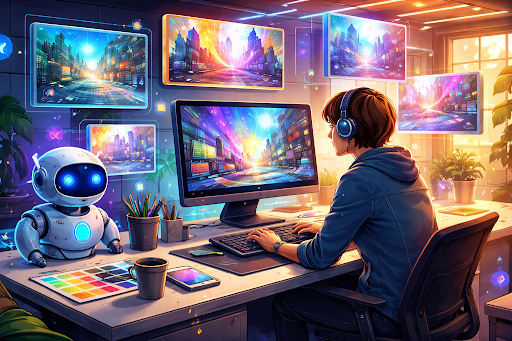
How Designers Use Artificial Intelligence to Speed Up Creative Workflows
In today’s fast-paced digital landscape, designers are under constant pressure to produce high-quality visuals at scale. Whether it’s for social media campaigns, branding projects, website assets, or ad creatives, the demand for compelling imagery has never been higher. Traditional workflows—brainstorming, sketching, refining, and rendering—are still essential, but they can be time-consuming.
This is where advanced image-generation tools are transforming the way creative professionals work. Instead of starting with a blank canvas, designers can now begin with a prompt and instantly generate visually rich concepts. One of the most talked-about platforms in this space is midjourney AI, which allows users to create stunning images from simple text prompts in seconds.
But the real story isn’t just about faster image creation. It’s about how designers integrate these tools into structured, repeatable workflows that enhance creativity, reduce burnout, and improve turnaround time.
From Blank Canvas to Instant Concept
One of the biggest bottlenecks in design projects is the initial ideation phase. Brainstorming visual directions, sketching rough drafts, and searching for inspiration can consume hours—or even days.
With modern AI-driven tools, designers can convert abstract ideas into visual drafts almost instantly. By entering a descriptive prompt such as “luxury eco-resort lobby with warm lighting and biophilic design,” creatives receive multiple visual interpretations within seconds. This dramatically shortens the concept exploration stage.
Instead of spending hours sketching five variations, designers can generate dozens of interpretations in minutes. The result? Faster validation of ideas and more confident creative direction.
Enhancing Mood Boards and Visual Research
Mood boards are essential in branding, interior design, product packaging, and fashion projects. Traditionally, designers gather references from stock libraries, photography websites, or previous projects.
AI image generators accelerate this process by allowing designers to create custom references tailored to a specific theme or client brief. Rather than hunting for the “perfect” reference image, they generate one that matches their vision precisely.
For example, a branding designer working on a futuristic fintech startup can produce bespoke visual styles that align exactly with the brand narrative. This makes client presentations stronger and more cohesive.
Rapid Prototyping for Client Presentations
Clients often struggle to visualize abstract design concepts. Words and wireframes may not fully communicate the creative vision. This is where AI-powered visuals become especially powerful.
Designers use AI-generated drafts as high-fidelity prototypes during early-stage presentations. Instead of describing a concept verbally, they show a realistic preview. Even if the image is later refined or recreated manually, it provides immediate clarity.
Because midjourney AI generates detailed visuals so quickly, designers can iterate live during feedback sessions. If a client asks for a different color palette or atmosphere, a revised concept can be produced in minutes instead of days.
Speeding Up Social Media and Marketing Assets
Marketing teams demand constant content output—Instagram posts, banner ads, landing page visuals, and thumbnails. Creating each asset manually can overwhelm design teams.
AI-generated visuals help designers produce unique, scroll-stopping graphics at scale. Rather than relying solely on stock imagery, they can create custom artwork tailored to each campaign.
Interestingly, midjourney ai is now on invideo, making it even more accessible to creators who want to integrate advanced image generation into their content workflows. This integration streamlines the transition from static visuals to dynamic content production.
Supporting Creative Exploration Without Burnout
Creative fatigue is real. Designers often face tight deadlines, repetitive revisions, and creative blocks. AI tools act as collaborative assistants rather than replacements.
Instead of draining energy on repetitive mockups, designers can focus on higher-level creative strategy. They experiment with lighting styles, textures, and artistic approaches without worrying about time constraints.
The ability to instantly visualize bold or unconventional ideas encourages experimentation. Designers can test surreal, hyper-realistic, or abstract styles without committing hours to manual rendering.
This freedom often leads to more innovative final outputs.
Bridging the Gap Between Image and Video
Modern content ecosystems demand both static and motion assets. Designers are no longer confined to images alone; they’re increasingly involved in short-form videos, promotional reels, and brand storytelling.
While AI-generated images help with concept art and static visuals, many designers also transition these visuals into motion formats. Platforms like invideo make this easier by offering an ai video app that converts creative ideas into professional video content without requiring advanced editing skills.
This means designers can move seamlessly from concept image to animated brand asset, expanding their creative output without expanding their workload.
Improving Collaboration Across Teams
In large creative teams, communication gaps can slow projects down. Art directors, copywriters, marketing managers, and clients often interpret briefs differently.
AI-generated visuals serve as a universal communication tool. Instead of debating abstract descriptions, teams align around tangible visuals early in the process.
When everyone sees a realistic preview of a concept, misunderstandings decrease. This leads to fewer revisions, faster approvals, and more efficient workflows overall.
Reducing Production Costs
Photography shoots, 3D modeling, and custom illustrations can be expensive. While these methods still have their place, AI-generated imagery provides a cost-effective alternative for early drafts and exploratory phases.
Designers can validate concepts using AI before investing in full-scale production. If a direction doesn’t resonate, adjustments can be made instantly without incurring additional expenses.
This approach allows agencies and freelancers to deliver high-quality work within tighter budgets—something especially important for startups and small businesses.
Personalizing Designs at Scale
Today’s audiences expect personalization. Brands tailor visuals to different demographics, regions, and platforms. Manually creating variations for each segment is labor-intensive.
AI tools enable designers to generate multiple customized variations from a single prompt structure. For example, a campaign visual can be adapted for different seasons, cultural themes, or target markets with minimal effort.
This scalability is particularly valuable for e-commerce brands, SaaS companies, and digital marketers managing global campaigns.
Elevating Skill Sets Instead of Replacing Designers
There’s often debate about whether AI will replace designers. In reality, these tools enhance human creativity rather than eliminate it.
AI can generate ideas, but it doesn’t understand brand nuance, emotional storytelling, or strategic intent the way a skilled designer does. The most effective workflows combine AI speed with human judgment.
Designers curate, refine, edit, and contextualize AI outputs. They apply typography, layout principles, brand consistency, and user experience knowledge that machines alone cannot replicate.
When used strategically, AI becomes a powerful assistant—handling the heavy lifting of concept generation while designers focus on craftsmanship and storytelling.
Building a Future-Ready Workflow
To fully benefit from AI-powered tools, designers are restructuring their workflows:
- Prompt Ideation Phase – Define detailed prompts aligned with the project brief.
- Rapid Concept Generation – Generate multiple visual drafts in minutes.
- Curate and Refine – Select the strongest concepts and refine them manually.
- Client Feedback Loop – Iterate quickly using updated prompts.
- Final Production – Polish and adapt assets for multiple formats.
This structured approach ensures that AI enhances productivity without compromising quality.
The Competitive Advantage
In a competitive market, speed matters. Agencies that deliver faster turnarounds without sacrificing quality gain a clear edge. Freelancers who can explore more ideas in less time increase their value proposition.
AI-driven design tools empower creatives to meet modern demands efficiently. They enable faster ideation, stronger presentations, improved collaboration, and scalable production.
The designers who thrive in this evolving landscape aren’t those who resist change—they’re the ones who adapt and integrate intelligent tools into their creative process.
By embracing AI as a collaborative partner, designers unlock a new level of efficiency and innovation—transforming not just how quickly they work, but how creatively they think.