
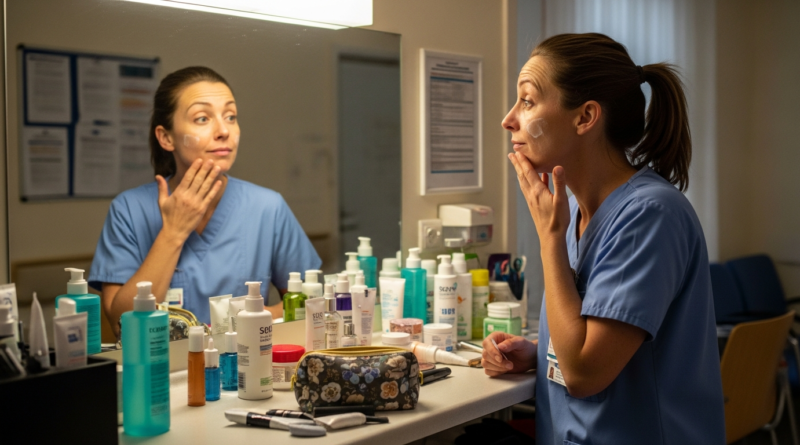
Self-Care Sunday: How Healthcare Workers Maintain Their Beauty Routines During Demanding Shifts
Working in healthcare means your schedule doesn’t exactly align with typical beauty routines. When you’re pulling 12-hour shifts or rushing between emergency calls, finding time for self-care becomes an art form. But here’s the thing — the healthcare workers I’ve talked to have figured out some pretty brilliant ways to look and feel their best, even when their job demands everything they’ve got.
These aren’t your typical Instagram-worthy routines with 15 steps and perfect lighting. They’re real, practical solutions from people who understand that sometimes you’ve got five minutes in a hospital bathroom to make yourself feel human again.
The 3-Minute Face Reset Between Shifts
Dr. Sarah Chen, an emergency room physician in Seattle, swears by what she calls her “reset ritual.” Between her 6 AM to 6 PM shifts, she’s developed a routine that takes exactly three minutes and fits in her locker.
“I keep micellar water wipes, a tinted moisturizer with SPF, and a lip balm that doubles as cheek tint,” she explains. “The whole thing fits in a makeup bag smaller than my stethoscope case.”
Here’s what makes this work: multitasking products. That lip balm isn’t just for lips — she dabs it on her cheeks for a natural flush. The tinted moisturizer gives her coverage while protecting her skin from those harsh hospital fluorescent lights.
But Sarah’s secret weapon? She keeps a small bottle of facial mist in her lab coat pocket. “Every few hours, I spray it over my mask area. It’s like hitting refresh on my skin.”
The key insight here is preparation. These products are chosen specifically because they work under pressure, literally. When you’re wearing N95 masks for hours, your usual foundation isn’t going to cut it.
Night Shift Beauty Hacks That Actually Work
Working nights throws your entire routine out the window. Jessica Martinez, a trauma nurse who’s been working night shifts for five years, had to completely rethink her approach to skincare and makeup.
“Your circadian rhythm is already messed up, so your skin reflects that,” she tells me. “I had to become strategic about when I do what.”
Jessica’s discovered that her skin responds differently at 3 AM than it does at 3 PM. She uses a heavier night cream during her shift (which is technically her daytime) and switches to lighter products when she gets home in the morning.
Her game-changing discovery? Under-eye patches. “I keep them in the break room fridge. Five minutes during my meal break, and I look like I actually slept.” The cold temperature helps with puffiness while the patches deliver hydration exactly where she needs it most.
For makeup, she’s learned that less is definitely more during night shifts. “I focus on my eyebrows and lips. Everything else just disappears under the mask anyway.” She uses a brow gel that holds for 12+ hours and a long-wearing lip stain that won’t transfer to her mask.
Emergency Responders’ On-the-Go Wellness
EMTs face unique challenges — they’re constantly moving, exposed to different environments, and never know when they’ll get their next break. Mike Rodriguez, who’s been an EMT for eight years, has perfected the art of mobile self-care.
“My ambulance is basically my mobile spa,” he jokes, but he’s not entirely kidding. He keeps a small bag with essentials: hand cream (because constant hand washing destroys your skin), lip balm with SPF, and what he calls “emergency deodorant.”
Mike’s biggest tip? Invest in quality basics. “I used to buy cheap hand cream and wonder why my hands were still cracking. Good products work faster, which matters when you only have seconds to use them.”
For aspiring EMTs preparing for certification, taking an nremt practice test is just part of the preparation process. But what they don’t tell you in training is how much the job affects your daily routines — including your beauty regimen.
Mike also discovered that staying hydrated isn’t just about health — it’s about looking good too. “I keep electrolyte packets in my bag. When you’re properly hydrated, your skin shows it. Plus, it gives me energy for those long calls.”
The Science Behind Stress-Proof Beauty
Healthcare workers deal with stress levels that would break most people. According to the American Psychological Association’s research on workplace stress, healthcare professionals report some of the highest stress levels across all industries.
This stress shows up on your skin, in your hair, and in your overall appearance. Dr. Chen explains it perfectly: “When you’re running on adrenaline for 12 hours straight, your body prioritizes survival over vanity. Your skin gets the message.”
That’s why traditional beauty advice often falls flat for healthcare workers. You can’t fight stress with a face mask when you’re intubating someone in the ICU. Instead, these professionals have learned to work with their reality, not against it.
The National Institute for Occupational Safety and Health recommends specific wellness practices for healthcare workers, though they don’t usually include beauty tips. But the principle is the same: small, consistent actions that support your wellbeing.
I’ve found that the most successful routines among healthcare workers share three common elements: they’re fast, they’re portable, and they multitask. No one has time for a 10-step skincare routine when lives are on the line.
Building Sustainable Self-Care Habits
The healthcare workers who maintain their beauty routines long-term don’t rely on willpower — they rely on systems. They’ve automated the decisions and made their routines so simple that skipping them feels harder than doing them.
Jessica puts it best: “I don’t think about whether I want to wash my face after a shift. It’s just what happens, like taking off my scrubs.”
So here’s what happens when you make beauty care automatic: it stops feeling like another task on your endless list and starts feeling like a moment of normal in an abnormal job.
The most important lesson from these healthcare heroes? Self-care isn’t selfish, even in a profession dedicated to caring for others. Taking those few minutes to reset your appearance isn’t vanity — it’s maintenance. And just like the equipment in the hospital, you need regular maintenance to function at your best.
Whether you’re just starting your healthcare career or you’ve been at it for decades, remember that taking care of yourself enables you to take better care of others. Your patients deserve your best self, and your best self deserves a little care too.